Google Search Central Live Bengaluru 2026: The Numbers, 10 Strategic Shifts and What to Do Next
AI Mode, AI Overviews and the numbers Google shared at Search Central Live Bengaluru 2026, plus 10 strategic SEO shifts and what to do about each.

By Bhavishya Jain, Organic Growth and AI Search Specialist
Published , 8 minute read
In this article
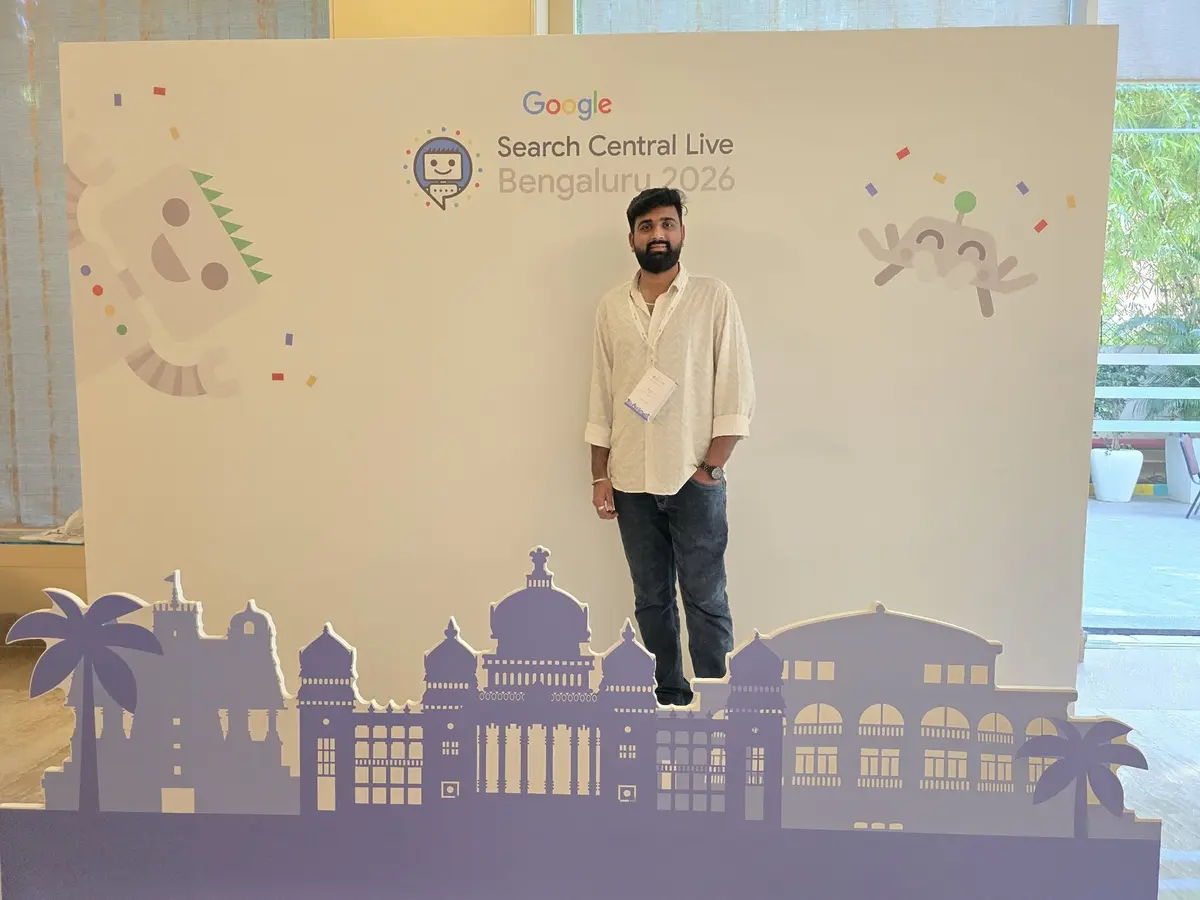
On 30 October 2026, I spent a full day at Google Search Central Live in Bengaluru with Gary Illyes, Cherry Prommawin and the Google Search team. The biggest takeaway wasn’t a new feature. It was this: AI didn’t change how Google reads the web. It changed which page gets chosen.
Googlebot still crawls for Search, AI Overviews and AI Mode alike, and all of them draw on the same index. What’s new happens at serving time. So the question for every SEO is no longer “Do I rank?” It’s “Am I the page the system picks to answer?”
This post covers every number Google shared on stage, the 10 shifts I think matter most for strategy, and one move to make for each.
The numbers Google shared
The opening keynote made one point with data: AI is expanding search, not draining it.
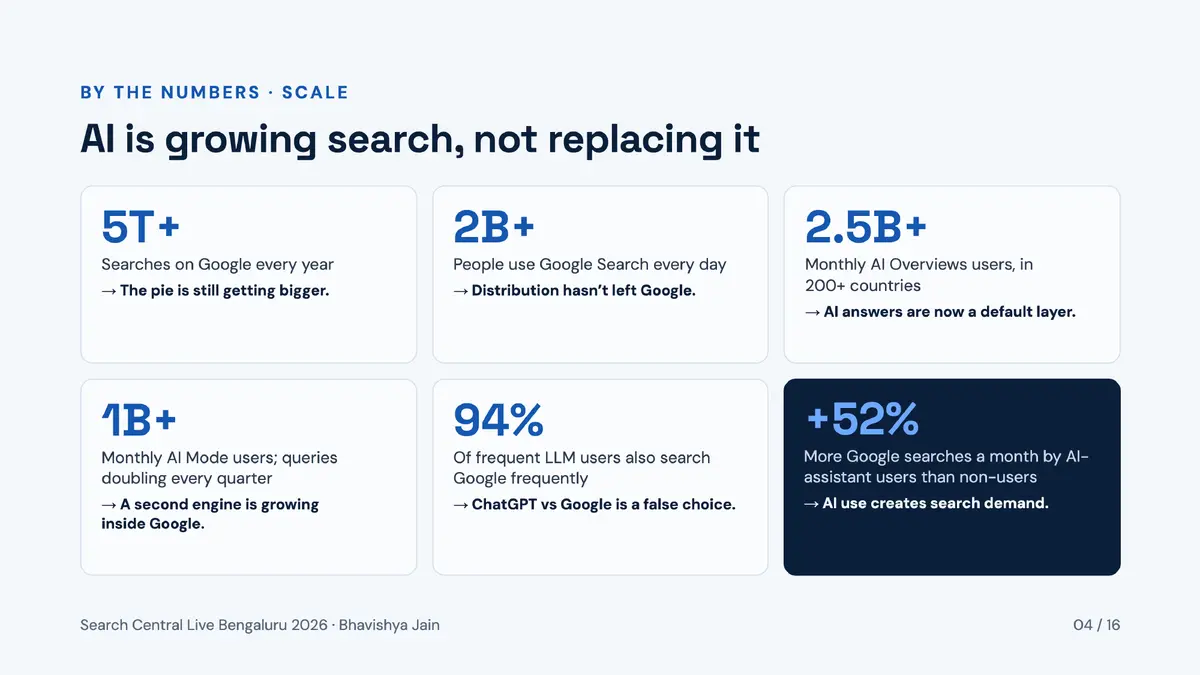
| Number | What it measures | What it means |
|---|---|---|
| 5 trillion+ | Searches on Google every year | The pie is still growing |
| 2 billion+ | People using Google Search every day | Distribution hasn’t left Google |
| 2.5 billion+ | Monthly AI Overviews users, in 200+ countries | AI answers are now a default layer |
| 1 billion+ | Monthly AI Mode users, with queries doubling every quarter | A second engine is growing inside Google |
| 94% | Frequent LLM users who also search Google frequently | ChatGPT vs Google is a false choice |
| +52% | More Google searches a month by AI-assistant users than non-users | AI use creates search demand |
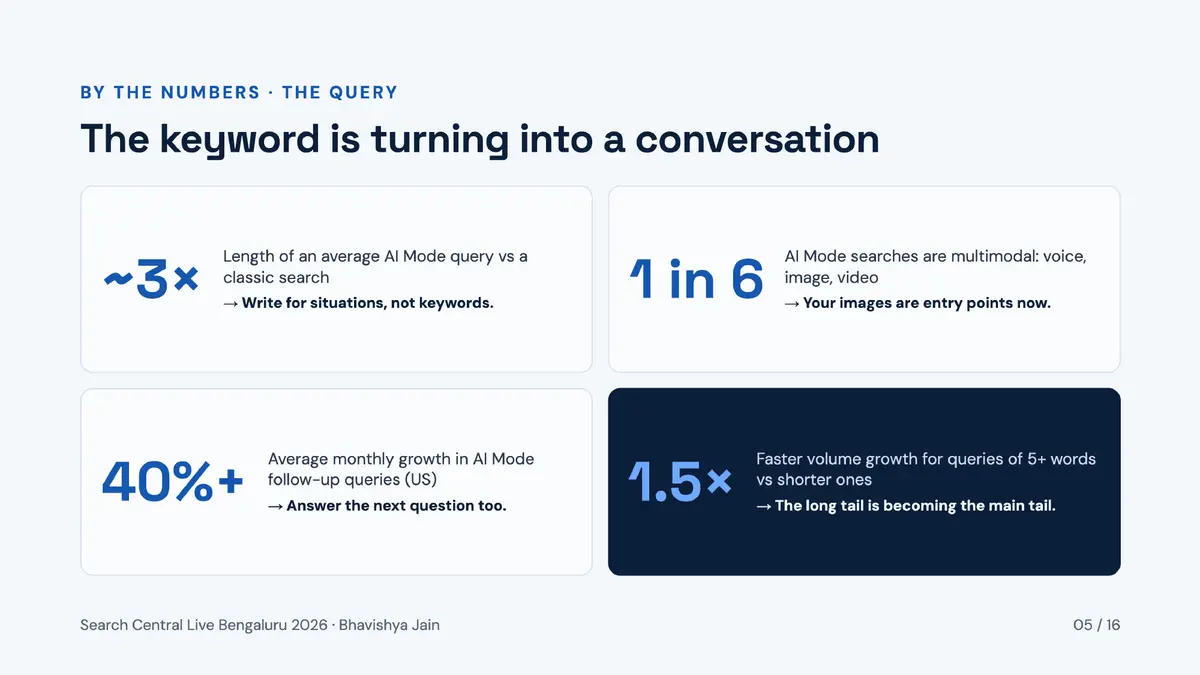
The query itself is changing
- AI Mode queries are about 3x longer than a traditional search.
- 1 in 6 AI Mode searches is multimodal: voice, image or video.
- Follow-up queries in AI Mode grew 40%+ a month on average in the US.
- Queries of five or more words are growing 1.5x faster than shorter ones.
The keyword is turning into a conversation. Pages built around one phrase will lose to pages built around a situation, and the follow-up question that comes after it.
10 strategic shifts from Search Central Live Bengaluru
1. Your page can now win, or lose, a query you never targeted
Google was direct: crawling and indexing are identical for Search and its AI features. AI adds two things at serving time, grounding on the Search index and query fan-out. As Gary Illyes put it, if you know how Search works, you largely know how the AI features work.
Fan-out quietly runs related sub-queries the user never typed. Your page can be pulled into an answer for a question you never targeted, or lose to whoever answered it better.
Your move: map the 5–10 sub-questions behind each money query, and make sure one page on your site is the best answer to each.
2. The growth isn’t in “what is”. It’s in “which one”
- “Which” searches grew 40% faster than AI Mode overall in the past six months.
- Planning queries grew 80% faster.
- Brainstorming queries grew 30% faster than queries overall since launch.
- 71% of shoppers on Google say they are open to trying new brands.
Comparing and choosing is where AI answers need sources most, and most shoppers haven’t picked a brand yet. That’s where a challenger can win.
Your move: build opinionated “which X for Y” pages with your own criteria, data and trade-offs.
3. Your local page might be invisible, and your canonical tag won’t save it
Google groups duplicate and near-duplicate pages into clusters, then picks one representative URL using ML-weighted signals. A rel=canonical is a signal, not a guarantee. Boilerplate-only localization, or the same language across country sites (xyz.com and xyz.in), can land in one cluster.
Your move: localize the main content, not just the header. Use hreflang with return links, redirects for migrations and consistent canonical signals.
4. Translating your site won’t make people trust it
Google said AI search makes multilingual SEO more important than ever, and it determines a page’s language from its visible content. Survey data shown on stage: to trust international brands, 64% of shoppers look to expert recommendations, 53% to certifications and 52% to transparency about sourcing.
Your move: translate the proof, not just the copy. Use local experts, certifications, reviews and examples on every market page.
5. Commodity content is the first thing AI absorbs
Google defined quality as the effort, originality, talent and skill, and accuracy that went into a page, judged across your site as a whole. Its systems find 40 billion spammy pages a day. Google’s own example: “7 tips for first-time homebuyers” is replaceable; “Why we waived the inspection and saved $15k” is not.
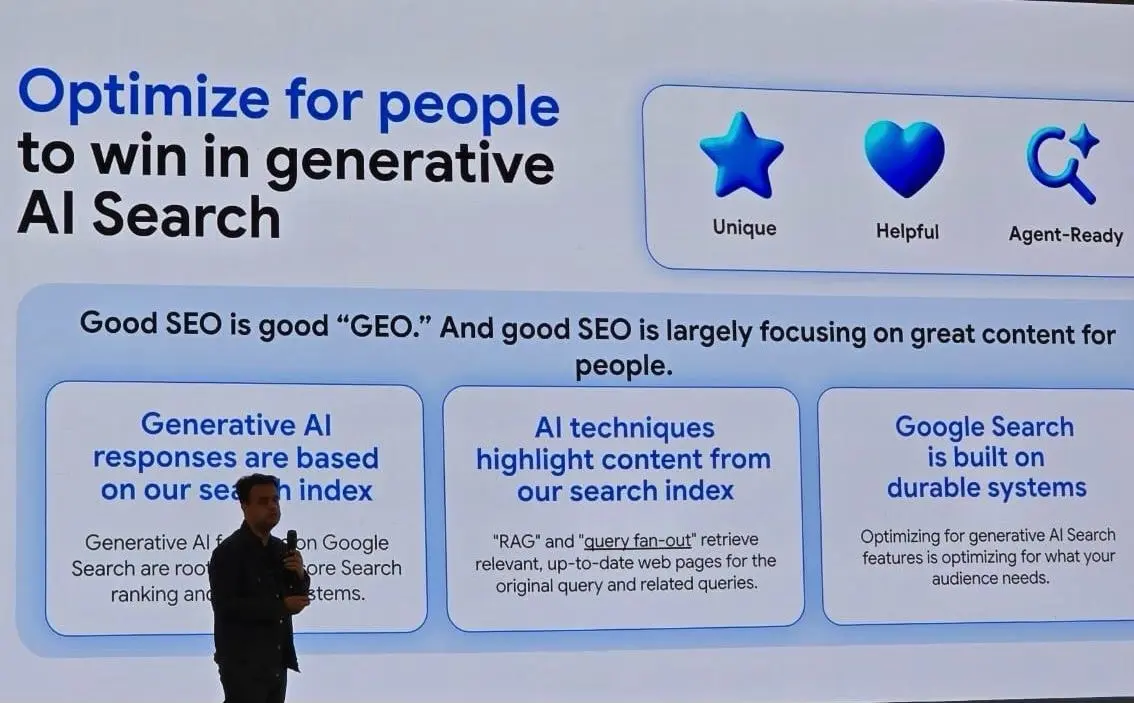
Google also said “made for Search” content will not succeed, and long-held traffic is likely to fluctuate.
Your move: every month, feed real cases, numbers and mistakes from sales, support and operations into your content.
6. There’s no Discoverbot. There’s a trust gate.
If a page is indexed in Search, it’s eligible for Discover. It then passes a policy filter and an E-E-A-T check, where untrustworthy pages fail regardless of other factors. The feed is shifting to fresh (under 48 hours), multi-format, creator-led content with high-resolution images. In India, templated clickbait and misleading AI imagery were filtered out once Search quality systems came to Discover.
Your move: show who wrote each story and why they’re credible, use large high-res images, and publish on a steady rhythm.
7. Your audience can now pull you into their AI answers
New surfaces: a claimable Search Profile for publishers and creators, Preferred Sources (in Top Stories and labeled in AI Mode and AI Overviews), “Highly Cited” labels for original reporting, and subscription linking.
Your move: claim your Search Profile, ask readers to add you as a preferred source, and publish data others will cite.
8. Blocking Google-Extended doesn’t keep you out of AI search
| Control | What it affects | Watch out |
|---|---|---|
| Search Console “Search generative AI” setting | Your links, content and grounding in AI Overviews and AI Mode | Exclude means no traffic or impressions from those features |
| Google-Extended in robots.txt | Future Gemini training and grounding in Gemini Apps and Vertex AI | Doesn’t un-train existing models or remove you from AI search |
| llms.txt | Nothing at Google | Google doesn’t use it |
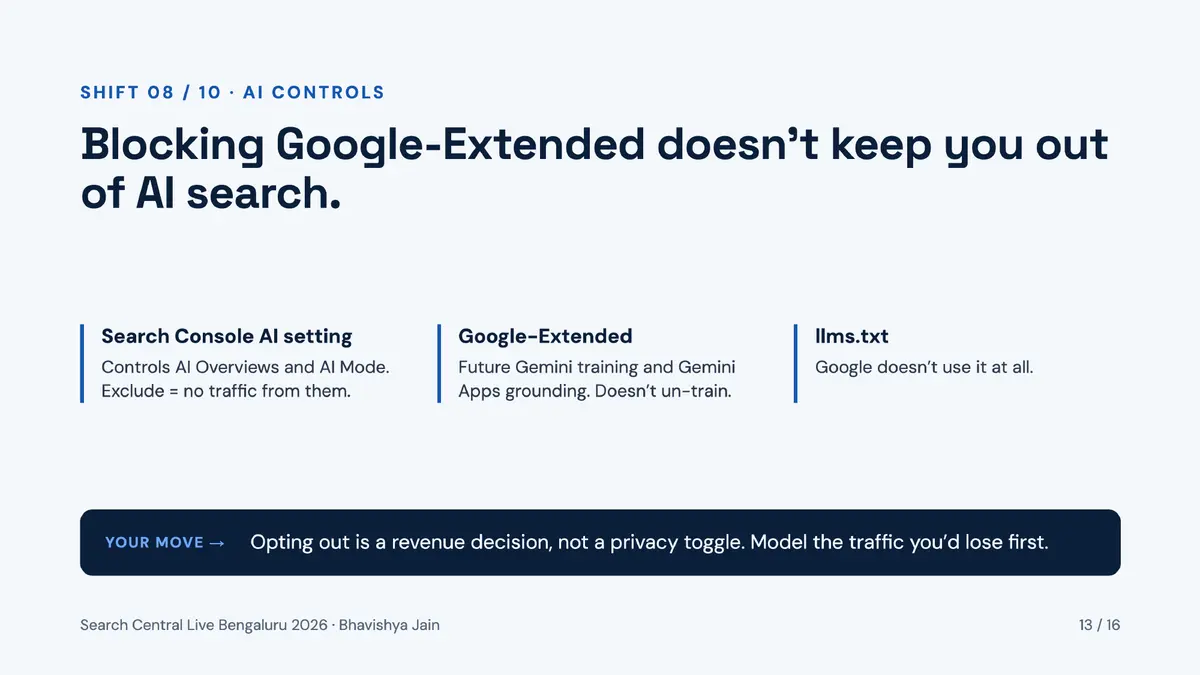
Your move: treat opting out as a revenue decision, not a privacy toggle. Model the traffic you’d give up first.
9. Your traffic report is hiding the AI-era story
Search Console now classifies branded and non-branded queries automatically, across languages and typos. It also adds weekly and monthly views, custom annotations, hourly data through the API, and insights for Lens and Circle to Search.
Your move: report branded and non-branded separately, annotate every release and Google update, and judge success on business outcomes. My SEO automations do the weekly Search Console checks for you.
10. AI bots won’t eat your crawl budget, but they can slow Googlebot
Crawl rate depends on how fast your site responds and on server errors. “Discovered – currently not indexed” often means Google expected to overload your site and rescheduled. AI scrapers don’t use your crawl budget, but if they push your server into errors, Google slows down.
Your move: rate-limit non-search bots, alert on 5xx errors served to Googlebot, and treat server headroom as an SEO metric. A free site audit will show the broken and slow pages first.
SEO myths Google busted on stage
| Myth | What Google said |
|---|---|
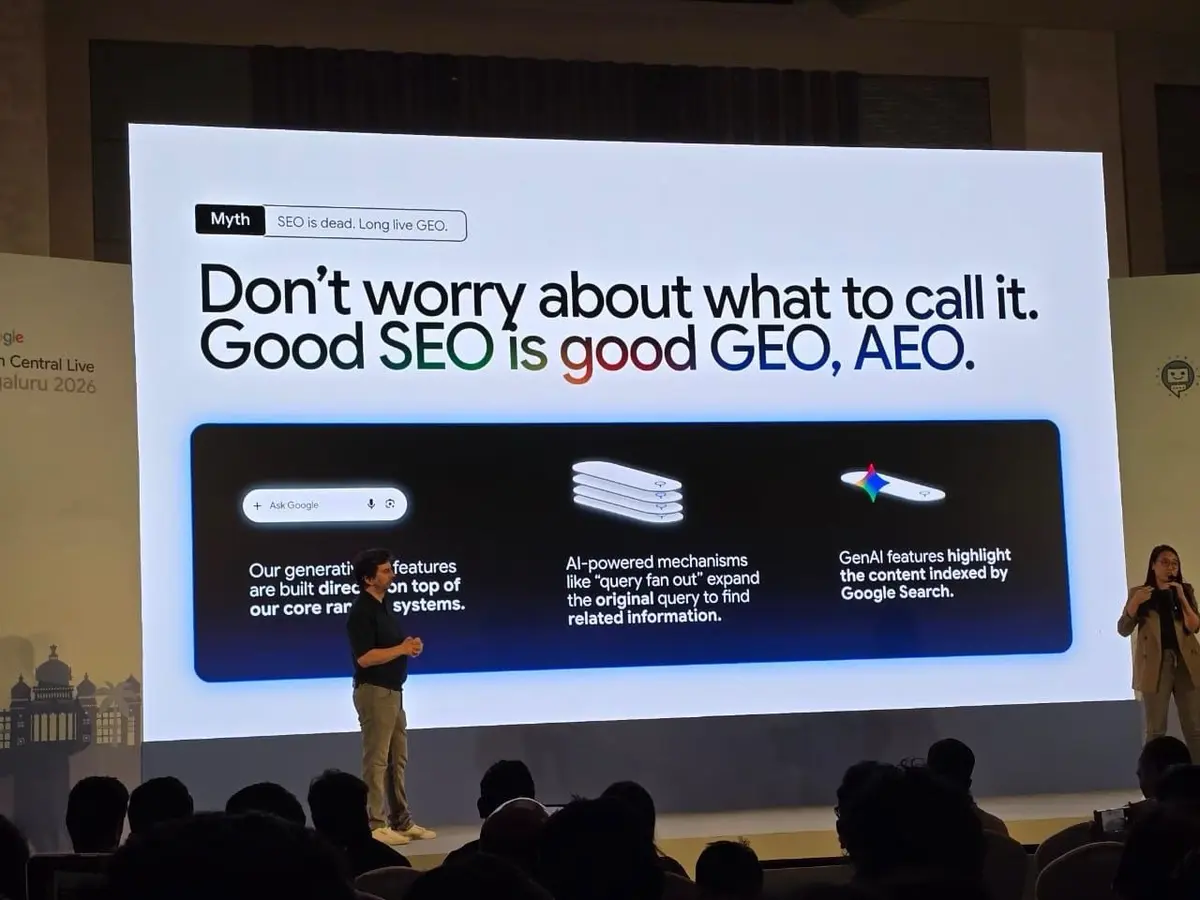
| SEO is dead, long live GEO | Good SEO is good GEO and AEO |
| llms.txt is how you talk to Google’s AI | Google doesn’t use llms.txt |
| Google prefers Markdown over HTML | False; rendering sees what users see |
| Rank #1 and AI will cite you | Ranking first doesn’t guarantee a citation |
| AI only cites Wikipedia and Reddit | AI regularly cites a brand’s own site when it’s relevant and authoritative |
| Raters’ guidelines are ranking factors | Nothing in the guidelines is a ranking factor |
What I’d do this week
- Map the sub-questions behind your top 20 money queries.
- Check that the right local URL is the one Google picks in each duplicate cluster.
- Split branded and non-branded in every report you send.
Search is never a solved problem, as the opening keynote reminded us. But the fundamentals held up better than the hype suggests. Good SEO is still good “GEO”. What changed is the tolerance for shortcuts.
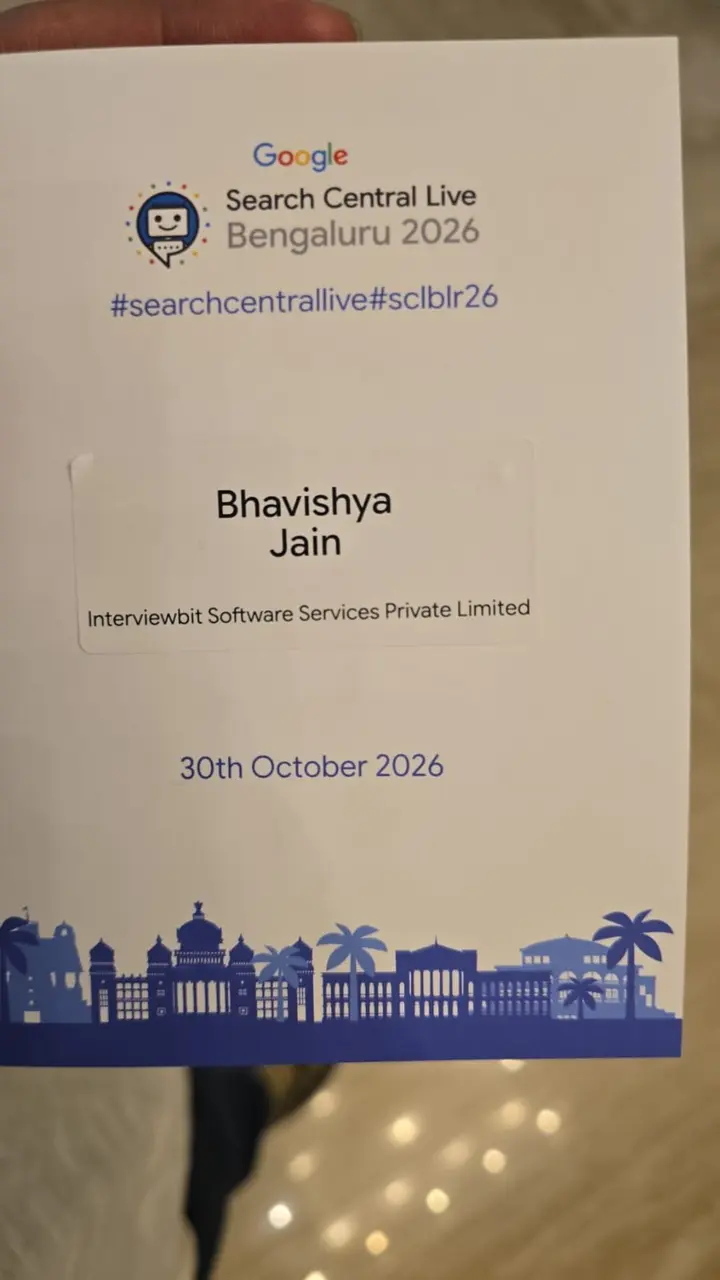
Thanks to Gary Illyes, Cherry Prommawin, Nitin Sharma, Aaseesh Marina and the Google Search team for a dense, candid day.
FAQ
Is SEO being replaced by GEO?
No. Google said its generative AI features are built on its core ranking systems, so good SEO is good GEO.
Does Google use llms.txt?
No. Google said it doesn’t use the instructions or data in llms.txt files.
Does blocking Google-Extended remove my site from AI Overviews?
No. Google-Extended covers future Gemini training and grounding in Gemini Apps and Vertex AI. The control for AI Overviews and AI Mode is the new Search Console setting.
What is query fan-out?
It’s how AI Mode and AI Overviews expand a user’s question into related sub-queries, then retrieve pages from the Search index to answer them.
About the author: Bhavishya Jain is an SEO and organic growth consultant based in India who has built organic growth in-house at Thrillophilia, Journey Routers and Scaler. Connect on LinkedIn.